
Project overview
This project improves safety along State Route 104 in Jefferson County at Shine Road/Paradise Bay Road and at State Route 19. At SR 19, a single-lane roundabout has been built. At Shine Road/Paradise Bay Road, a single-lane metered roundabout will be built. During peak congestion, the meter will create gaps between vehicles on westbound SR 104 to allow motorists from Paradise Bay Road to enter the roundabout.
What to expect
All roadway work at the State Route 104/SR 19 intersection is complete.
All roadway work at SR 104 and Paradise Bay Road/Shine Road is complete. The new traffic meter on westbound SR 104 is active.
A new pole for a future traffic camera will be installed in fall 2026.
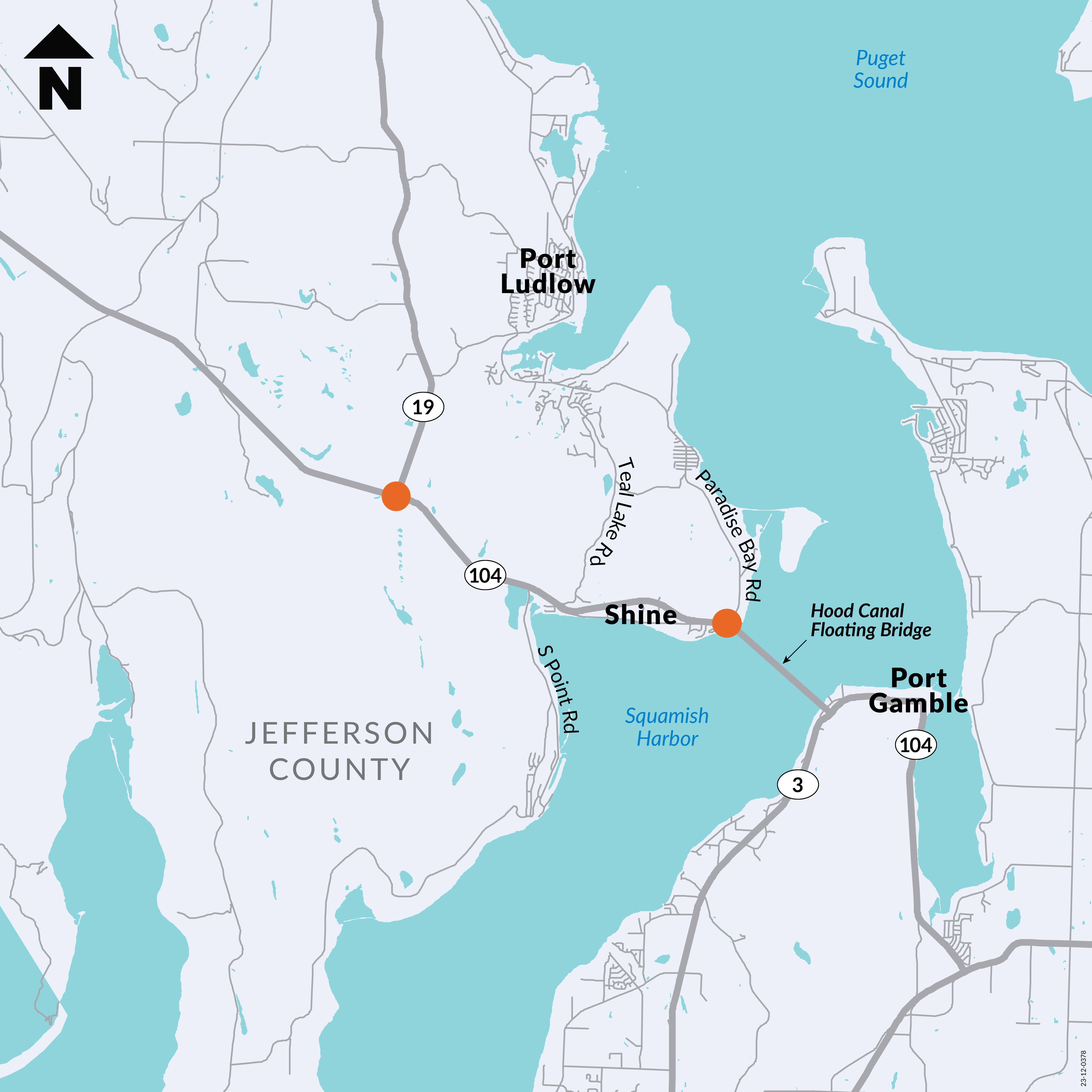
Beginning in May 2024, contractor crews will start construction of two roundabouts on State Route 104.
The intersection of State Route 104 and Paradise Bay-Shine Road Jefferson County has a history of serious-injury collisions. Nearly 17,000 vehicles and semis travel SR 104 each day, the only highway on or off the Olympic Peninsula. As such, WSDOT decided the intersection needed a closer look.
In February 2019, WSDOT published a Intersection Control Evaluation (ICE) report that analyzed traffic volumes and movement, safety considerations and operational efficiencies at these locations. The study recommended a single-lane, metered roundabout be built at Shine Road/Paradise Bay Road and another roundabout SR 19 to improve the flow of traffic and reduce the potential and severity of head-on or serious injury collisions.
Studies have shown that roundabouts are safer than a traditional stop sign or signal-controlled intersection. Roundabouts:
- Promote lower travel speeds and continuous traffic flow. Roundabouts force drivers to slow down and allow them to safely continue on their journey with less delay when compared to a signal.
- Are designed to accommodate the largest legal loads, including semis.
- Reduce the potential for head-on or t-bone type collisions.
- Are more environmentally-friendly than signals. Roundabouts have a smaller carbon footprint and produce less "hot spots."

