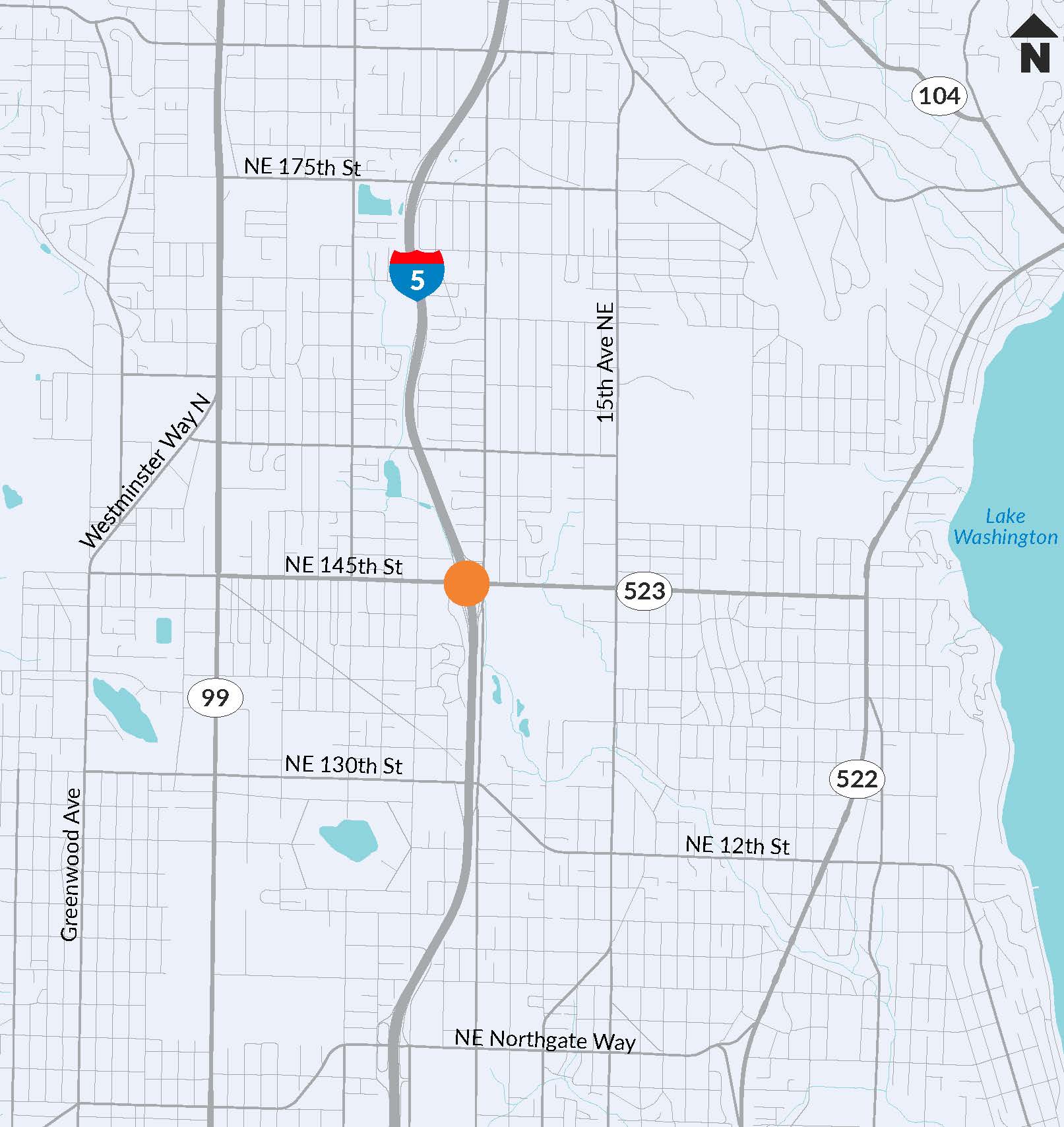
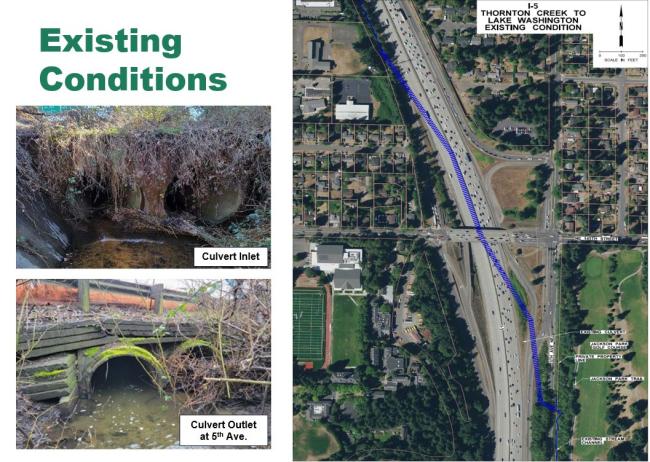
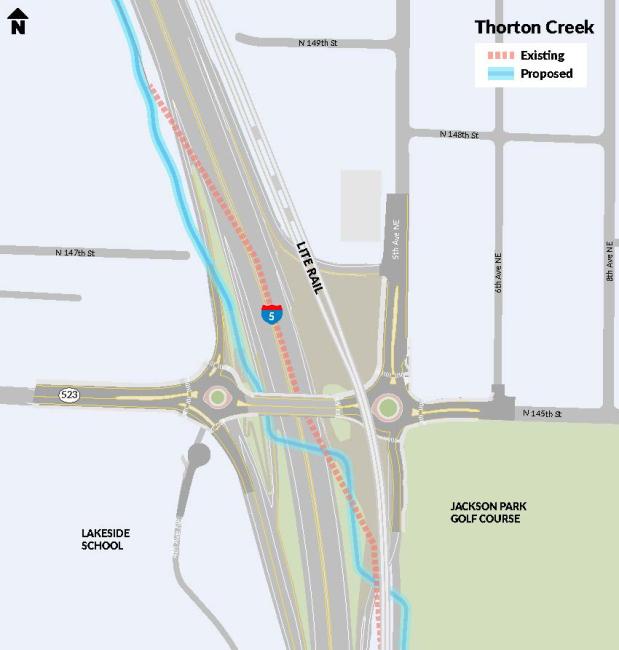
Thornton Creek is a tributary to Lake Washington crossing under I-5 near the border of Seattle and Shoreline. Thornton Creek’s I-5 crossing begins on the west side of the highway, just north of the intersection with SR 523/Northeast 145th Street and ends on the east side of I-5 on 5th Avenue Northeast near Jackson Golf Course. As the creek crosses I-5, it is funneled through two, 6-foot concrete culverts for 2,000 feet under the highway. The creek is only 33 percent passable and fish need to navigate 2,000 feet in the dark.
When replacing fish barriers, we must build structures and improve the stream so that fish can use it year-round at all stages of their life. That means during summer months when streams are usually lower, the stream must be usable by juveniles and adults. During winter, when water tends to run higher and faster, the stream must also have areas where fish can rest.
New fish passable structure
To replace the existing culverts, WSDOT will rechannelize the creek using three new fish-passable structures. With the new structures, a good portion of the rechanneled stream will be open to the air in contrast to being buried under I-5 as it is now. We'll also add woody vegetation, logs and other wood to this section of Thornton Creek to provide channel complexity and diversity, such as pools which provide refuge for young fish. These habitat elements enhance rearing and spawning habitat for fish. The improvements mean fish will have access to 1.8 miles of habitat that was previously inaccessible.
This work is part of our fish passage program. Replacing the existing culverts and rebuilding the stream channels expands healthy fish habitat; an important step in restoring fish runs and increasing populations. This benefits commercial seafood operations and recreational fishers and provides more food for a declining orca population. Additionally, replacing these fish barriers helps us meet our obligation to remove barriers under the 2013 U.S. District Court injunction.
Other projects in the area
$56.01 million from Pre-Existing Funds (PEF), the Connecting Washington Account (CWA) and Move Ahead Washington (MAW).
Thorton Creek’s two existing 6-foot culverts cross under I-5 for 2,000 feet and do not allow fish to pass.
Thornton Creek’s new creek alignment with three fish-passable structures will replace the existing fish barrier.