• Project

SR 20 - Campbell Lake Road - Intersection Improvements

The temporary speed limit on eastbound and westbound SR 20 is 40 mph near Campbell Lake Road (mileposts 45.48 to 46.62) during a six-month settlement period. An advisory speed of 30 mph is posted through a curve where banking was removed.

Project overview

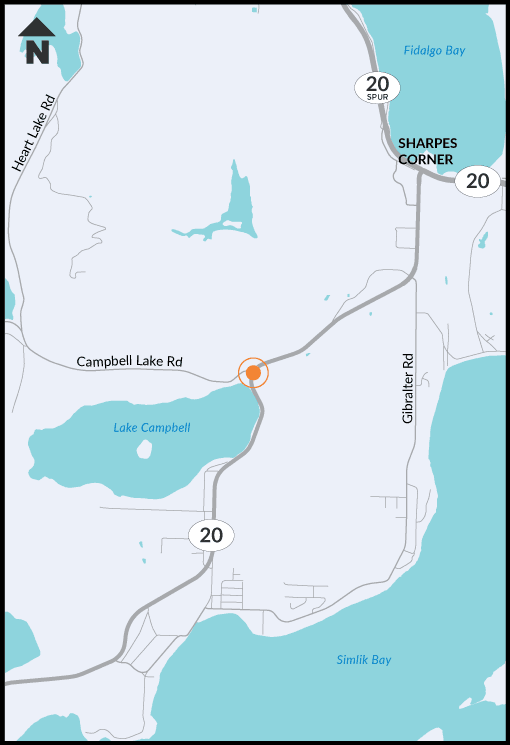
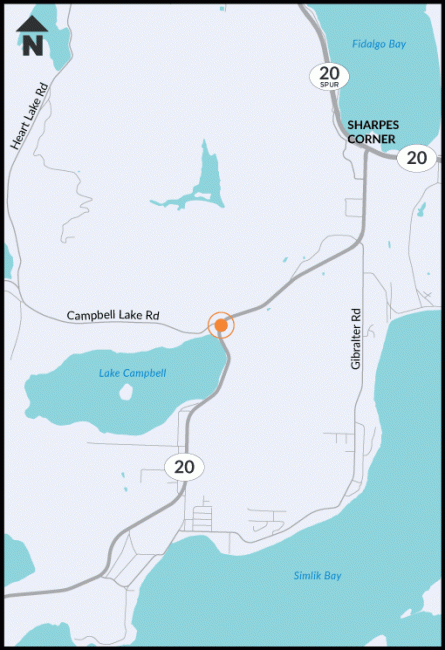
The Samish Indian Nation is partnering with WSDOT and Skagit County to improve safety and access at the intersection of SR 20 and Campbell Lake Road. The project is funded by the Samish Indian Nation.

The SR 20 Campbell Lake Road Intersection Improvements project will construct a new roundabout at the intersection of SR 20 and Campbell Lake Road in Skagit County (milepost 46). The roundabout will help improve safety and mobility at the three-way intersection.

The project also will rechannelize Tribble Creek through the WSDOT mitigation site to the east of the interchange. This work will improve the quality of the stream for fish.

Timeline
Summer 2026 - fall 2027
Project status
Pre-construction
Funding
$3 Million

What to expect

Construction will be spread across two years in seven phases. Construction in 2026 focused on rechannelizing Tribble Creek and building the roadbed beneath eastbound SR 20 to the grade required for the new roundabout. The project is now in a six-month settlement period until spring 2027, and the roundabout will be built begingin in spring 2027. 

Construction will require SR 20, a vital link between Whidbey Island and Skagit County, to be reduced to single lane for up to 54 days around the clock during the spring and summer. People traveling through the area during lane reductions should plan for delays.

The Samish Indian Nation is partnering with WSDOT and Skagit County to build a new roundabout at the SR 20 intersection with Cambell Lake Road.

In 2016, the Samish Indian Nation approached WSDOT about improving safety and access to their land south of SR 20 between Tibbles Lane and Campbell Lake Road. The tribe originally proposed widening SR 20 near Tibbles Lane to address safety concerns relating to access of tribal property. Challenges associated with this proposal encouraged the Samish Indian Nation and WSDOT to take a broader approach in partnership with Skagit County that also considered safety and access to and from Campbell Lake Road. 

Regional use

The SR 20 corridor provides the primary access to Whidbey Island, as well as local Skagit County Fidalgo Island communities; serving more than 18,000 vehicles per day, including 1,000 trucks/buses. This intersection has seen a 20% increase in traffic over the past five years. 

A partnership was formed to explore a practical solution to better meet regional transportation needs. Working together with Skagit County, WSDOT and the Samish Indian Nation reviewed alternatives that would support development and improve mobility in this area.

Stages of construction

This project will be built in seven stages spread across 2026 and 2027:

  • Stage 1 – Stream realignment (complete): Crews will divert Tribble Creek while they excavate and build a new channel for the creek. No lane closures are expected during this stage of construction.
  • Stage 2 – Bringing east side of roundabout up to grade (complete): Crews will build up the roadbed beneath eastbound SR 20 to meet the final grade of the roundabout. A temporary layer of asphalt will be applied to be used by eastbound traffic during the five- to six-month settlement period that follows. SR 20 traffic will shift to the westbound lane around the clock for up to 19 days, and flaggers will alternate eastbound and westbound SR 20 and Campbell Lake Road traffic in a three-way configuration. 
  • Stage 3 – Settlement period (fall 206 to spring 2027): The five- to six-month settlement period will be from fall 2026 to spring 2027 and is crucial for ensuring the stability and longevity of the roundabout. No traffic control is expected during the settlement period.
  • Stage 4 – Developing east side of roundabout (spring 2027): After the settlement period, crews will build eastbound SR 20, including the eastern third of the roundabout center island and eastern half of the splitter islands on SR 20. SR 20 traffic will shift to the westbound lane around the clock for up to 14 days, and flaggers will alternate eastbound and westbound SR 20 and Campbell Lake Road traffic in a three-way configuration. 
  • Stage 5 – Developing north side of roundabout (spring/summer 2027): Crews will widen Campbell Lake Road to the north and build the north third of the roundabout, including the northern third of the roundabout center island, completing the SR 20 splitter island on the north end of the roundabout and the north half of the Campbell Lake Road splitter island. SR 20 traffic will shift to the eastbound lane, and Campbell Lake Road traffic will shift to the eastbound lane around the clock. Flaggers will alternate eastbound and westbound SR 20 and Campbell Lake Road traffic in a three-way configuration for up to 22 days. 
  • Stage 6 – Developing the southwest side of roundabout (summer 2027): Crews will excavate the south side of Campbell Lake Road and finish building the roundabout, including the final third of the roundabout center island and completing the splitter islands on the southern end of SR 20 and Campbell Lake Road. SR 20 traffic will shift to the eastbound lane, and Campbell Lake Road traffic will shift to the westbound lane around the clock. Flaggers will alternate eastbound and westbound SR 20 and Campbell Lake Road traffic in a three-way configuration for up to 18 days. 
  • Stage 7 – Permanent striping and sign installation (summer/fall 2027): SR 20 and Campbell Lake Road will each be reduced to a single lane with flaggers alternating three directions of traffic nightly. Nighttime lane reductions are allowed from 8 p.m. to 6 a.m. Sundays through Friday mornings.

Roundabout safety

Roundabouts are designed to make intersections safer and more efficient for drivers, pedestrians, and cyclists. Studies have shown that roundabouts are safer than traditional stop sign- or traffic signal-controlled intersections. Roundabouts reduced injury crashes by 75% at intersections where stop signs or traffic signals were previously used for traffic control, according to a study by the Insurance Institute for Highway Safety (IIHS). Studies by the IIHS and Federal Highway Administration (FHWA) have shown that roundabouts typically achieve:

  • A 37% reduction in overall collisions
  • A 75% reduction in injury collisions
  • A 90% reduction in fatality collisions
  • A 40% reduction in pedestrian collisions

They do this by lowering ravel speeds, promoting continuous, circular movement without a light to beat and using one-way travel around the roundabout to reduce the risk of dangerous head-on and T-bone collisions.