
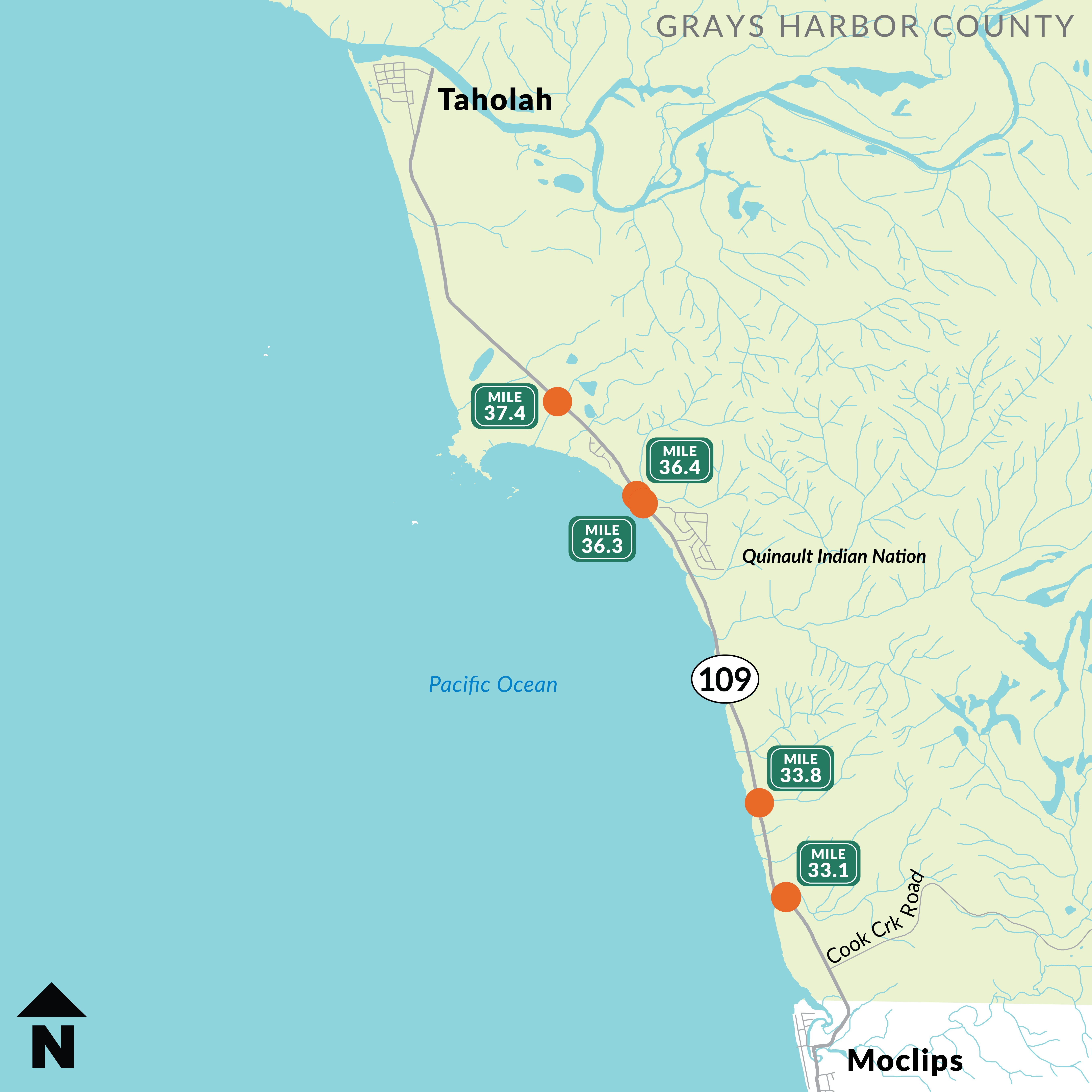
From 8 a.m. to 4 p.m. Friday, Oct. 16, SR 109 will close four times at milepost 33.1 near Moclips Highway. The closures will last up to 45 minutes each.
Project overview
This project will remove five barriers to fish under SR 109 on the Quinault Indian Nation.
What to expect
Travelers will see a total of four locations with temporary traffic lights and one-way alternating between Taholah and Moclips. The temporary changes will remain in place around the clock through fall 2026.
Do not pass red traffic lights. The temporary signals are there for traveler and worker safety.
Girder placement
In mid-October, travelers will see two days of 45-minute closures while crews place girders, or large support beams, on the new bridge at the work zone near Moclips Highway.
From 8 a.m. to 4 p.m. Friday, Oct. 16, SR 109 will close four times at milepost 33.1. Travelers can also expect traffic stops up to 15 minutes on Thursday, Oct. 15, while workers move cranes into and out of the work zone.
Need for this work
State highways cross over rivers and streams in thousands of locations throughout Washington. Some crossings can impede fish migration. WSDOT is working to improve fish passage and foster healthy waterways by removing barriers that limit or prevent fish from feeding, migrating and reproducing.
A fish passage barrier is anything that hinders fish from moving upstream or downstream. Culverts, large pipes under roadways, allow water to flow but may not allow fish to swim through. Culverts may block fish migration because the water flow is too swift, too shallow, or has a waterfall into or out of the culvert.
Working to comply with the requirements of a 2013 U.S. District Court injunction, WSDOT corrects barriers to salmon and steelhead within the case area. The area is primarily located in western Washington.
As of June 1, 2026, WSDOT has corrected 200 injunction barrier culverts. This work has improved access to 705 miles of potential habitat for salmon and steelhead in the injunction area. Statewide, WSDOT has completed 483 fish passage barrier corrections since the 1990s when the Fish Passage Program was created.
Summer construction
Crews can only work in the water during a limited time. Construction must occur inside a “fish window.” This is when working in the water will be the least disruptive to aquatic life. The fish window is usually in summer. WSDOT thanks travelers in advance for their patience and understanding. Other work can occur when crews do not work in the water.
