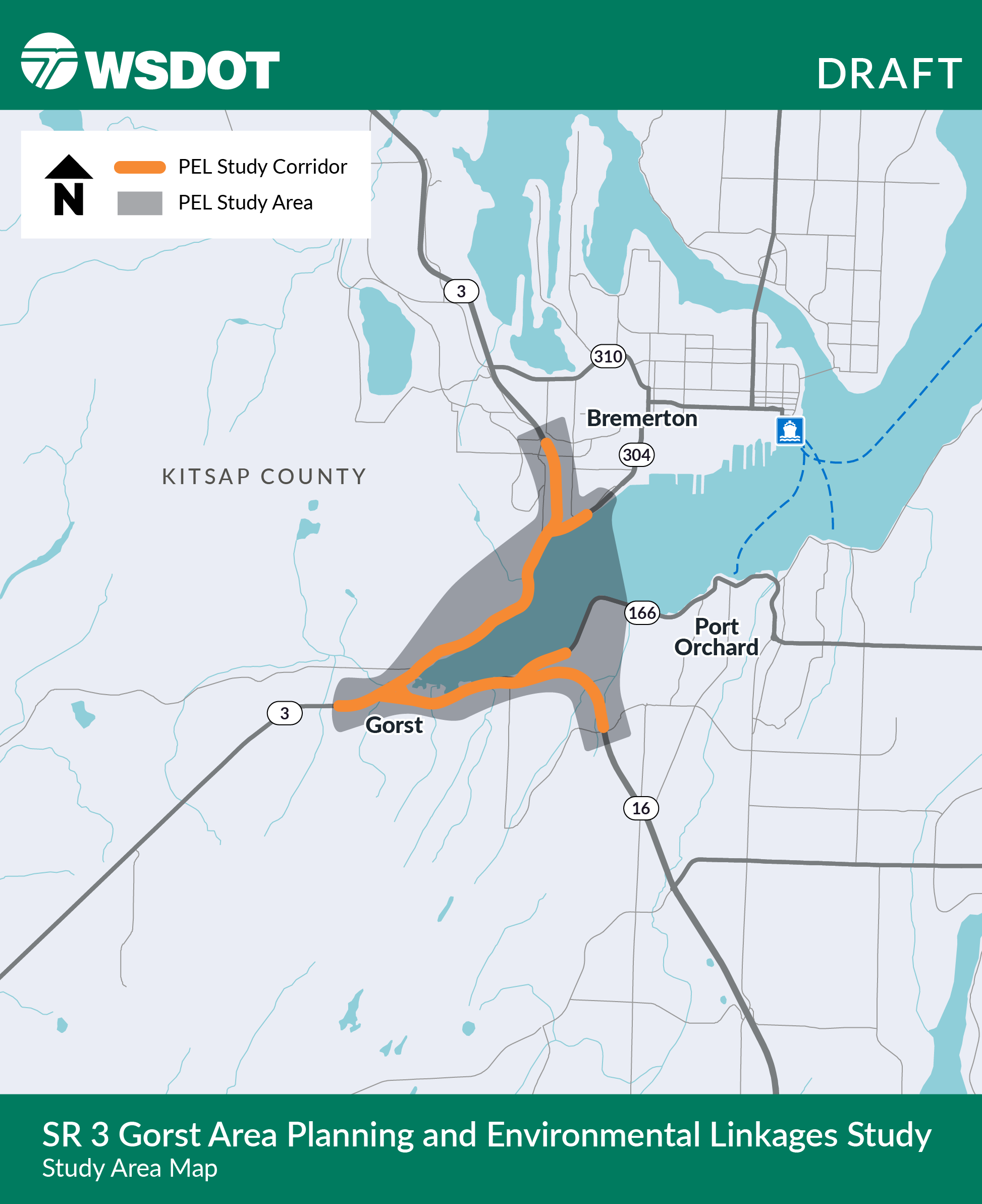
Congestion on State Route 3 and SR 16 in Gorst is significant for the entire region. Each highway is important for matters of national security. Both state highways are the only land-based route to the Kitsap Peninsula and experience congestion. The key routes are susceptible to liquefaction due to earthquake. There also is the potential for issues related to sea level rise caused by climate change.
WSDOT received $74.3 million from Move Ahead Washington funds for the design and right of way phases. There is currently no plan or funding for construction.
Community engagement
Environmental Justice Assessment
The Healthy Environment for All (HEAL) Act is an environmental justice law. The HEAL Act works to reduce environmental and health impacts in Washington. Under the HEAL Act, this study will perform an environmental justice assessment (EJA).
The EJA will help WSDOT identify potential negative impacts of the study. WSDOT aims to reduce potential impacts to vulnerable and overburdened groups. The EJA process ensures that the community has the chance to help shape decisions on this study.
Advisory Groups
WSDOT is putting together three advisory groups during the PEL study: a community, executive, and technical advisory group.
The Community Advisory Group (CAG) will be made up of representatives from community-based organizations, local businesses and institutions, and people with lived experience of travelling in the study area. The CAG will inform the study by sharing input, providing perspective on community values and priorities, and helping share information with community members.
Community partner interviews
In October, we held six listening sessions with community groups. Read a summary of these listening sessions (PDF 1.2MB).
Pop-up events
In February, we hosted two community pop-up events. One was at Coffee Oasis on Burwell Street and the other was at Silver City Brewery Taproom on Katy Penman Avenue, both in Bremerton. Members of the study team shared materials to introduce the study, shared the draft Purpose and Need statement and range of design concepts and gathered input from the community.
Open houses
Online open house
An online open house was held from Feb. 19 to March 11. The online open house covered a draft Purpose and Need statement and a draft range of alternatives for SR 3 in Gorst and the surrounding area.
In-person open house
An in-person open house was held Wednesday, Feb. 26 at Naval Avenue Elementary School in Bremerton. The open house gave 110 attendees the opportunity to view the draft Purpose and Need statement and range of design concepts and have conversations with our study team.
Meetings
Technical Advisory Group, meeting 1 (Nov. 19, 2024)
Executive Advisory Group, meeting 1 (Nov. 20, 2024)
Below is a schedule of planned activities for the SR 3 Gorst Planning and Environmental Linkages Study. The schedule spans from June 2024 through March 2026. It includes Data Assembly, Purpose and Need, Methods and Assumptions, a Range of Alternatives, Existing Conditions, Screening of Alternatives, and when the final report is expected. It also includes meetings with the Federal Highway Administration, Tribal nations, specifically the Suquamish and Skokomish Tribes, other advisory group meetings and public open houses.
June 2024
PEL process begins
Feb. 19 - March 11, 2025
Online open house held for range of alternatives and draft Purpose and Need
Feb. 26, 2025
In-person open house held at Naval Avenue Elementary School in Bremerton
November 2025
Draft EJA Report complete
March 2026
Final report expected
The Washington State Legislature committed $75 million of state and federal funding over several years. The funding covers the PEL Study and National Environmental Policy Act (NEPA) process(es), right-of-way acquisition, and preliminary design. There is currently no construction funding identified.
The result will be a PEL Report signed by WSDOT and the Federal Highway Administration (FHWA) and an implementation plan for conducting the environmental review.