
Project overview
This project is in the planning phase. This phase will evaluate the need for a new interchange on Interstate 5 at 156th Street Northeast in Marysville. This work includes determining the need for improvements near this interchange. WSDOT will determine a non-access solution is appropriate and whether an Access Revision Report (ARR) is warranted. If an ARR is needed, it would assesses whether a new I-5 interchange is appropriate and supports a request for federal approval. If the Federal Highway Administration approves the ARR, the project may move into design.
The work aims to improve access to north Marysville and the Smokey Point employment center, while supporting planned industrial and residential growth in the area and help reduce peak period congestion at the nearby I-5/State Route 531 (172nd Street Northeast) interchange.
What to expect
The project team will evaluate existing conditions and a purpose and need for this area and determine whether an ARR is needed to support a potential new interchange on I-5 at 156th Street Northeast.
There will be no construction at this stage. Current work is focused on planning, analysis and coordination.
If the ARR is approved, the project could move into design and construction.
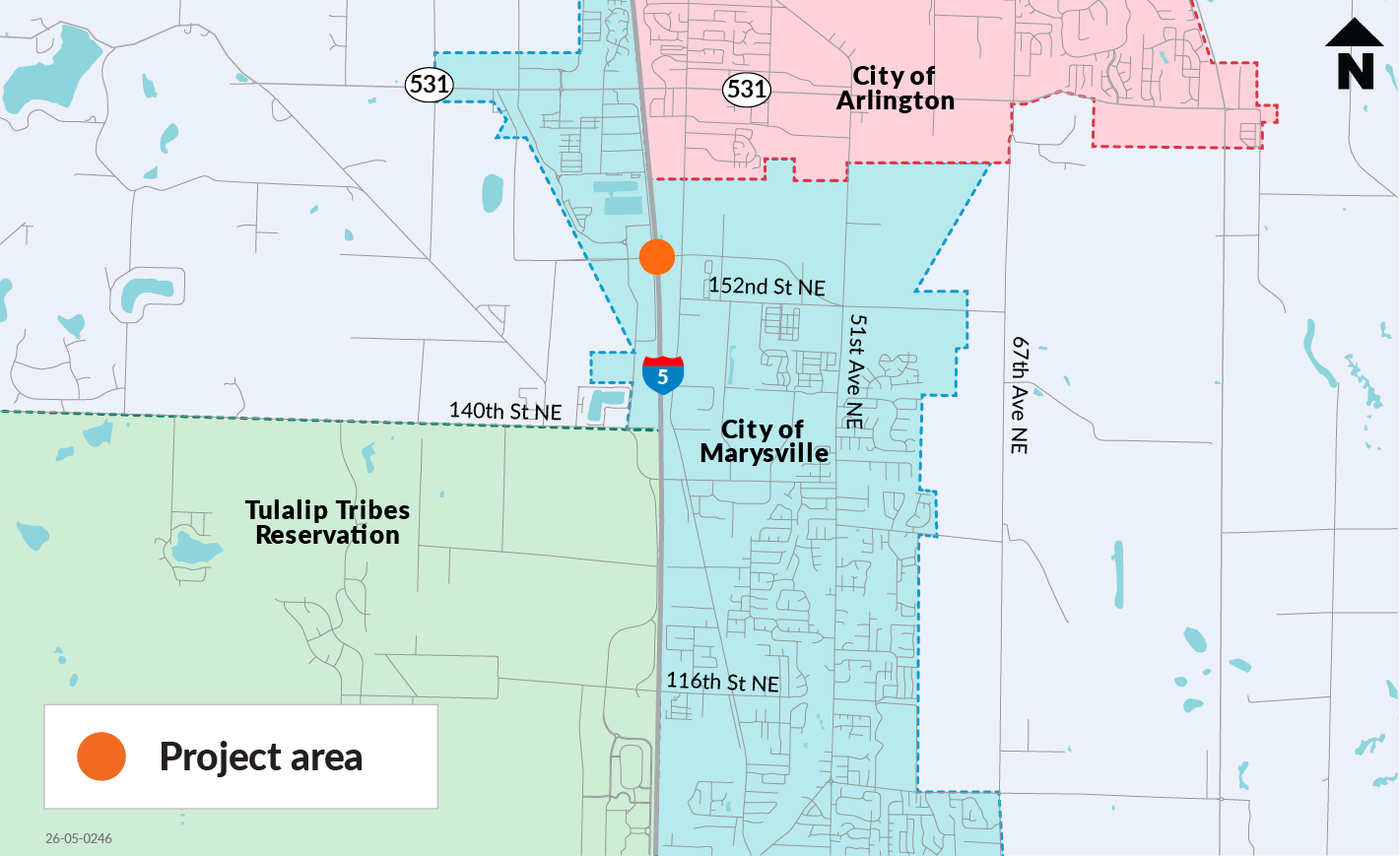
This project will evaluate a potential new interchange on I-5 at 156th Street Northeast in Marysville.
Traffic in Marysville and the Smokey Point area has increased steadily over the past several decades and continues to grow. Between 2021 and 2025, average daily traffic volumes within the study area increased by approximately 10%. More housing, expanding industrial activity and increased regional travel demand have all contributed to higher traffic volumes on local roadways, I-5 and nearby I-5 interchanges.
Today, the I-5/SR 531 (172nd Street Northeast) interchange is the main access point for north Marysville and Smokey Point. As growth has continued, this interchange has become more congested, particularly during peak travel times. In response, WSDOT, the City of Marysville and regional partners have been working together to identify ways to improve access and mobility along this part of the I-5 corridor.
The City has identified 156th Street Northeast as an important east-west connection in its long-range transportation plans. Planned improvements include roadway improvements and a new bridge over the BNSF railroad to improve connectivity. These projects are intended to support continued economic growth and improve how people move through the area.
As part of this broader effort, WSDOT is studying a potential new interchange at 156th Street Northeast. Because I-5 is part of the federal Interstate Highway System, any new or modified access requires approval from the Federal Highway Administration through an ARR. This process provides a structured way to evaluate the need, understand potential impacts and identify a solution that meets federal requirements.
Funding for this effort was included in the state’s 2015 Connecting Washington package, allowing WSDOT to begin this evaluation.
Healthy Environment for All (HEAL) Act
This project is subject to Washington's environmental justice law, known as the Healthy Environment for All (HEAL) Act. Environmental justice in Washington State, as provided in the HEAL Act, addresses disproportionate environmental and health impacts in all laws, rules and policies by prioritizing vulnerable populations and overburdened communities, the equitable distribution of resources and benefits and eliminating harm (RCW 70A.02.010).
Complete Streets
Complete Streets means planning, designing and operating transportation facilities that meet the needs of all modes of transportation. Complete Streets alternatives will be developed as the ARR progresses.
Engagement
WSDOT will work with partner agencies, Tribes, local jurisdictions and the community throughout this planning effort, with opportunities to stay informed and provide input.
Community engagement
Community engagement will be conducted throughout the project. Specific engagement opportunities will be shared as the project advances.
Partner engagement
We intend to set up two support groups with agencies and partners to provide policy and technical feedback and inform WSDOT during the ARR. The Technical Support Group consists of public works, engineering and planning staff from WSDOT, local, regional, state and tribal entities. The Technical Support Group serves an advisory role to WSDOT providing technical feedback at multiple points in the ARR process. The Executive Support Group includes elected officials and executives from WSDOT, local, regional, state and tribal entities.